An Oxbridge activity: steps and tips
In this guide we will give you the step by step instructions on how to create a complete Oxbridge activity. You can use it to create any type of activity under the Oxbridge English Teaching System, such as topic, vocabulary, structure or pronunciation activities for any communicative purpose. The video walks you through the whole process from beginning to completion with all the relevant parts, such as the objective, introduction, developments, wrap up and target language, and shows you how to include a variety of visual and written resources.
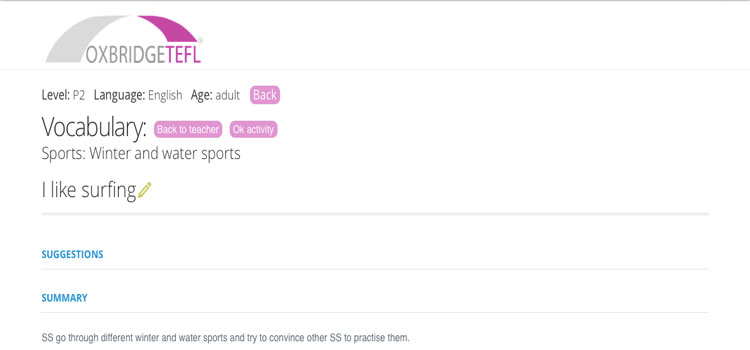
Guide to creating a complete Oxbridge activity
We consider a complete activity at Oxbridge to be one that provides good and engaging practice of the target language through a combination of elements, such as:
1. The
I DO - WE DO - YOU DO formula, consisting of first modeling the target language, then getting students to practice it with different tasks and activities and afterwards focusing on independent and accurate usage by each student
2.
GUIDED vs
FREE PRACTICE. Those two types of practices have to be present, thus giving students the chance to freely use the newly acquired language by asking more open questions that involve spontaneous usage of the TL.
Click this link to see the 1 page guide on creating an excellent activity!
Oxbridge Activity creation guide
Descriptors and grading system for any Oxbridge activity
This document contains detailed descriptors for a complete Oxbridge activity. It features all activity types, such as topic (speaking fluency) activities, structure (grammar) activities, vocabulary & pronunciation activities and activities for beginners (S1).
It can be used as a check list for teachers to make sure they have considered all aspects of a good activity before delivering it.
Click this link
Oxbridge Activity standards
This document shows you how we grade the activities at Oxbridge and what corresponds to a 5 star activity, 4 star activity and so on.
Click this link
Oxbridge Activity Grading System
Some tips to make the most of an Oxbridge activity
1. You can select a chunk of a video and copy it in the activity
a. Take the code from Youtube-Share-Embed contained between the inverted commas, as shown below:
b. To this code, you need to add the following one that would allow you to select the starting and finishing moment: ?start=10&end=120 The first number, 10, indicates that you want the video to start at second 10. The second number, 120, indicates that you want the video to finish at second 120. Remember that the numbers relate to seconds, so you have to always turn minutes into seconds. c. The selected chunk to watch therefore will contain the following code: https://www.youtube.com/embed/nCGHoYcTlwQ?ecver=1
?start=10&end=120
2. You can use the WYSIWYG (what you see is what you get) in the activity to edit the format by increasing the font size, aligning to the left, right or center, create a number list, use bold or italics, create a table, etc.
3. You can upload the recording of any text in the Target Language with the following tools:
a. Using
Sound of Text which allows you to download the sound of any text in dozens of languages b. Downloading
Audacity on your computer, a free program to record and edit sound.
4. Ideas for content
Now that the technical part is taken care of, we recommend that you take a look at some previous posts we shared for activity content inspiration.
How to enrich your activities by making them more engaging
Task based language teaching
How to set up audio visual discussion topics
New teaching techniques: Sparking inspiration
Your ideas are more than welcome!
