18 July 2016 / by Marjan Van Rij

Some tips for your English students during summer break

Have you already made plans for this summer? Going to the beach, the mountains or visiting family? What about your EFL or ESL students? Will they keep on studying English if they're not going abroad? It might be a good idea to give them something to do, right? Therefore I've listed here some activities to keep them busy in a easy way without you having to check any homework. So let the progress continue of your English students during summer break!
Cooking recipes

Give your students some cooking recipes in English which they can try out during summer break. Make sure that you give them everything in English: the grocery list and instructions. You can find recipes on the web with videos, with instructions (in American English or British English) or you can give them one of your own favourites. Here are two of mine: Chicken pot pie & scones. You can even take it to the next level and let your students organize an English evening in which they can play some charades, cook a lovely dinner and only speak English with eachother.
Ted Talks

A great platform for short interesting videos is Ted.com. Your students can search for any topics they like and watch a short (or longer) video about it. This website offers them full transcripts or subtitles in any language they prefer. Of course, it depends on your students which one will be best. That's why I recommend you to have a look beforehand and already select one or two videos for your students to watch. Some of my personal favourites are Why I keep speaking up & What makes a good life.
Lyrics training

A helpful tool to practise listening which English students can use on their own can be found on lyricstraining.com. Students can select the language of the songs and browse for any song they want to practise with. They're able to choose their own level (beginner, intermediate, advanced or expert) and listen to lyrics while doing a fill in the gap activity.

15

July 2016
ESL Course Design for the 2016-2017 Academic Year
by Max Zaman
With another academic year coming to a close, the teachers of Oxbridge Barcelona began to reflect on the year behind them and plan the ESL courses for the 2016-2017 academic year. We began by brainstorming on the activities and teaching methods that were well received by the students, but more importantly, helped students advance their Englis...

11

July 2016
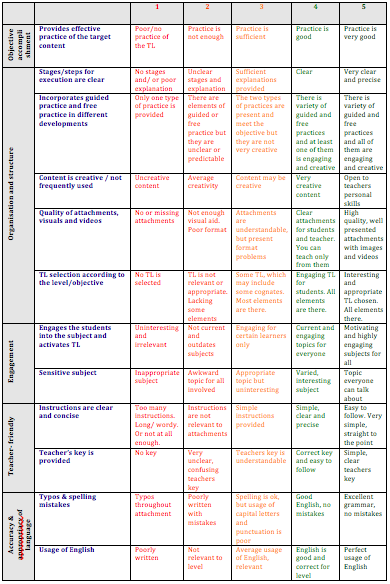
Grading activities. Creating unified criteria.
by Rob Wylie
In all of our classes we use activities which are written by us, the teachers, but how can we ensure that the activities work during a class? Here at Oxbridge we have adopted a five-star rating system for grading activities to ensure that we are able to evaluate all activities not onl...

07

July 2016
Can a non-native teach English? No way!
by Marjan Van Rij
“Where are you from?” is usually one of the first questions I get when I meet students for the first time. I am from the Netherlands (which isn't Holland by the way but that’s a different story). “But English is not the official language of the Netherlands, right?” Yes, that's right. Our official language ...

04

July 2016
English prepositions are easy with the in-on-at pyramid
by Marjan Van Rij
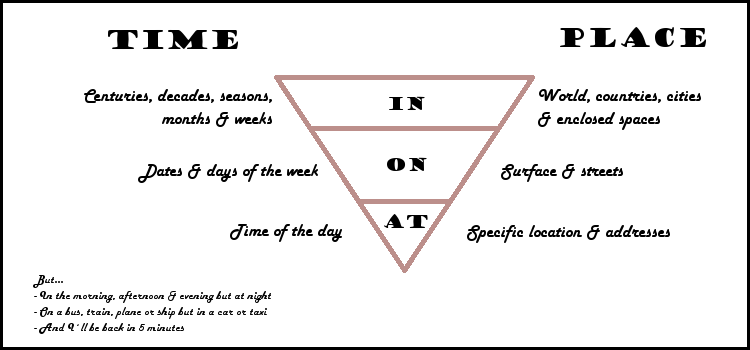
Are your students struggling to memorize the prepositions? Moreover isn’t it a bit confusing to explain all different examples? Why are my hands on the table, am I in the building and at the desk? Don’t worry. In, on and at is often confused among Spanish ESL students. Probably because these three prepositions can be translated to one Spanish...

01

July 2016
Are you capable of learning English?
by Marjan Van Rij
One of my students told me after his two-hour class by videoconference that he felt very comfortable because he was able to follow most of it. Still he didn’t feel comfortable enough to speak at any time. He is at a beginner’s level but far from a beginner. I am talking about a middle-aged man who has been studying English almost his entire l...

01

July 2016
Criteria for good activities
by Ana Garza
Here are some conclusions we, Madrid teachers, arrived to when discussing What do good activities include? These are internal working standards that we are now setting in order to unify criteria for what good activities should contain. Now we have more clues on what others mean...

29

June 2016
Why don’t we translate while we teach English?
by Marjan Van Rij
“... and all other things.” I saw the look in his eyes: panic. “Things? What is things?” Oops, I didn’t know this was a new word. Mentally slapping myself in the face for my own stupidity, I started explaining the word “thing”. I pointed at different objects in the room while using the word “thing” and referred to myself ...

03

June 2016
How to use cognates for beginners
by Max Zaman
When students make the decision to step into the classroom to learn English, they often nervous and feel intimidated. For them it is as if they are entering a new world where nothing looks familiar. Thus they can become withdrawn and shy. The situation can be difficult for the TEFL teacher as well as they struggle to connect with the students...

30

March 2016
The importance of teaching practice in TEFL training
by Rafael Olivares
Teaching English is a very complex process that involves knowledge about linguistics as well as about educational psychology. However, like everything else in life, there is the theory and then the reality. There is a Chinese proverb that says: I hear and I forget... I see and I remember... I do and I understand. This holds so very true...

02

March 2016
The power of dissatisfaction
by Ana Garza
Dissatisfaction tends to be associated with something negative, but it's actually quite powerful when one uses it wisely. One of the problems it brings is that its consequence tends to be criticising –and it ends up there. But the other day I read something that said that people who were satisfied with their ...